Topological ML Toolkit
Topological ML Toolkit teaches and implements topology as an engineering tool for machine learning pipelines.
Topology studies structure that survives continuous deformation. For ML, that means measuring shape instead of only coordinates: connected components, loops, voids, covers, neighborhoods, trajectories, and consistency constraints. Those measurements can become features, diagnostics, or routing rules.
Pipeline View
flowchart LR
  A["Raw data"] --> B["Point cloud, embedding, graph, or time series"]
  B --> C["Topological construction"]
  C --> D["Diagram, barcode, Betti curve, cover, or graph"]
  D --> E["Feature matrix or diagnostic"]
  E --> F["sklearn, PyTorch, TensorFlow, Rust systems"]
What Is Active Today
- Point-cloud persistent homology for dimensions 0 through 2.
- Time-delay embeddings for scalar time series.
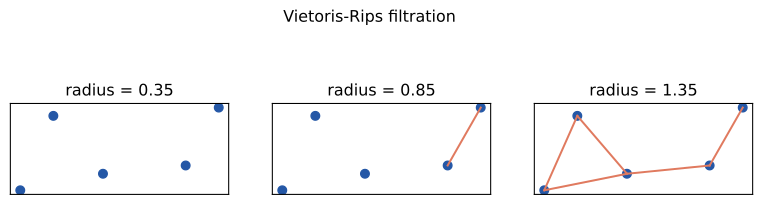
- Betti-number queries at chosen radii.
- Plotly-shaped persistence diagram traces.
PHFeaturizer, a sklearn-style transformer that emits fixed-width Betti curves.- TensorBundle-style interoperability descriptors for explicit metric spaces.
- Topology-augmented training helpers, sample weights, and a dependency-light random-forest baseline.
- Generated diagrams for docs and tutorials.
- E2E claim benchmarks that verify active behavior.
What Is API-Level Roadmap
The repository exposes an active C++ H0 native path, active hardware-gated ASM L2-squared dispatch, active optional CUDA and Triton pairwise-L2 runtime wrappers, and active optional PyTorch and TensorFlow tensor adapters. The docs do not claim acceleration until equivalence tests and benchmark baselines pass.
Learning Path
- Start with persistent homology to understand connected components, loops, and lifetimes.
- Convert diagrams into Betti curves and fixed-width feature vectors.
- Use manifold and embedding docs to connect topology to model activations.
- Use topological training to append shape features to tabular, tensor, or embedding pipelines.
- Read the topology landscape for broader families such as covers, Mapper, sheaves, homotopy, dynamical topology, stratified spaces, and quotient spaces.
- Check the benchmark pages before trusting any speed or backend claim.
Evidence Policy
Every active repository claim should have one of three forms:
- a unit test;
- an E2E claim benchmark artifact;
- a docs-only statement clearly labeled as theory or roadmap.
That standard keeps the project marketable without turning planned systems into unverified claims.